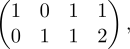
We begin with three different notions of independence arising from linear algebra, graph theory, and
matching theory. Remarkably, all three examples give rise to exactly the same collection of independent
sets.
Example 1.
Linear Independence.
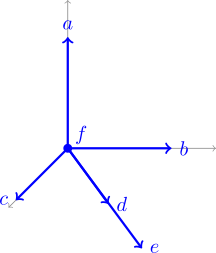
Consider the vectors a,b,c,d,e,f ∈ ℝ3 shown below.
A subset of E = {a,b,c,d,e,f} is called independent if the corresponding vectors are
linearly independent. The maximal independent sets are
Hence the independent sets are exactly all subsets of these five sets. For example, {a,b,d} is
independent, while {b,c,d,e} is dependent. Any set containing f together with three
nonzero vectors is dependent since f = 0.
Example 2.
Acyclic Edge Sets.
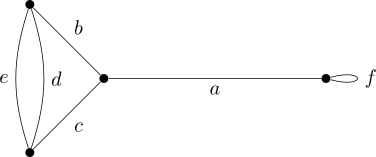
Consider the graph below with edge set E = {a,b,c,d,e,f}.
A subset of edges is independent if it contains no cycle. The maximal independent sets are
again
These are precisely the spanning trees of the graph. For example, {a,b,d} is independent,
while {b,c,d} is dependent since it forms a cycle. Any set containing the loop f is
dependent.
Example 3.
Matchings / Systems of Distinct Representatives.
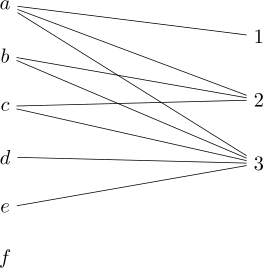
Consider the bipartite graph below.
Define
A subset of E = {a,b,c,d,e,f} is called independent if it admits a system of distinct
representatives, or equivalently, if it can be saturated by a matching. The maximal
independent sets are once again
For example, {a,c,d} is independent since we can match a → 1, c → 2, d → 3.
However, {b,c,d} is dependent because all three sets are contained in {2,3},
so Hall’s condition fails. The element f is dependent by itself since it has no
neighbour.
Thus, although the three examples come from very different areas of mathematics, they define exactly
the same family of independent subsets of E = {a,b,c,d,e,f}. This common abstract structure is called a
matroid.
2 Hereditary Set Systems
Definition 2.1.Let E be a finite set and let ℱ ⊆ 2E. The pair (E,ℱ) is a hereditary set system
if
Example 2.2.The following are hereditary set systems.
1.
Let G = (V,E) be a graph and ℱ = {F ⊆ E : F contains no cycle}.
2.
Let G = (V,E) be a graph and ℱ = {M ⊆ E : M is a matching}.
3.
Let G = (V,E) be a graph and ℱ = {S ⊆ V : S induces a clique}.
4.
Let G = (V,E) be a graph and ℱ = {S ⊆ V : S is an independent set}.
5.
Let E = {1,…,n} and fix an integer k. Define ℱ = {S ⊆ E : |S|≤ k}.
6.
Let E = {1,…,n} and define ℱ = S ⊆ E : ∑i∈Si ≤ 10.
However, this need not be a matroid. For example, {10},{4,5}∈ℱ with |{10}| < |{4,5}|, yet
neither {10,4} nor {10,5} belongs to ℱ, so the exchange property fails.
3 Matroids
Definition 3.1.A matroid is a pair M = (E,ℐ), where E is a finite set and ℐ⊆ 2E is a collection of
independent sets, satisfying:
(i)
∅∈ℐ.
(ii)
If I ∈ℐ and I′⊆ I, then I′∈ℐ.
(iii)
(Exchange axiom) If I1,I2∈ ℐ and |I1| < |I2|, then there exists e ∈ I2∖ I1 such that
I1∪{e}∈ℐ.
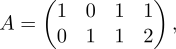
Example 3.2.Let
and let E = {1,2,3,4}, where element i corresponds to the i-th column of A. Define ℐ to consist
of those S ⊆ E for which the columns indexed by S are linearly independent.
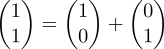
Then (E,ℐ) is a matroid. For example, {1,2}, {1,4}, and {2,3} are independent, while {1,2,3}
is dependent. For instance:
Proposition 3.3.Let A be a matrix with column set E, and let ℐ = {S ⊆ E :
S is linearly independent}. Then (E,ℐ) is a matroid.
Proof.We verify the matroid axioms.
(i)
∅∈ℐ.
(ii)
Every subset of a linearly independent set is linearly independent.
(iii)
Let I1,I2∈ ℐ with |I1| < |I2|. If every e ∈ I2∖ I1 satisfies I1∪{e}ℐ, then every
column in I2∖ I1 lies in span(I1), so span(I2) ⊆ span(I1), giving |I2| = dim(span(I2)) ≤
dim(span(I1)) = |I1|, a contradiction. □
4 Bases
Definition 4.1.A set B ∈ℐ is a basis of a matroid M = (E,ℐ) if it is maximal with respect to
inclusion, i.e. B ∪{e}ℐ for all e ∈ E ∖ B.
Proposition 4.2.All bases of a matroid have the same cardinality.
Proof.Let B1,B2 be bases with |B1| < |B2|. By the exchange axiom there exists e ∈ B2∖B1 such
that B1∪{e}∈ℐ, contradicting the maximality of B1. □
Theorem 4.3.Let ℬ⊆ 2Ebe a nonempty collection of subsets of E. Then ℬ is the collection of bases of
a matroid if and only if:
(i)
|B1| = |B2| for all B1,B2∈ℬ.
(ii)
For all B1,B2∈ℬ and e ∈ B1∖B2, there exists f ∈ B2∖B1such that (B1∖{e}) ∪{f}∈ℬ.
Proof.(⇒) If ℬ is the collection of bases of a matroid, all bases have the same size by the preceding
proposition, and the exchange property follows from the matroid axioms.
(⇐) Define
Clearly ℐ is hereditary. We verify the exchange axiom. Let I1,I2∈ ℐ with |I1| < |I2|, and
suppose for contradiction that I1∪{e}ℐ for every e ∈ I2∖ I1.
Choose B1⊇ I1 and B2⊇ I2 in ℬ. Applying the basis exchange property repeatedly, we replace
elements of B2∖(B1∪I2) by elements of B1∖B2, obtaining a new basis B2 with B2∖B1 = I2∖B1.
Our assumption implies I2∖ B1 = I2∖ I1 (if there existed e ∈ (I2∩ B1) ∖ I1 then I1∪{e}⊆ B1
would give I1∪{e}∈ℐ, a contradiction). Hence
contradicting |B1| = |B2|. □
Example 4.4.Let G = (V,E) be a graph and ℬ be the collection of spanning forests of G.
(i)
All spanning forests have the same size |V |−c(G), where c(G) denotes the number of connected
components.
(ii)
Let F1,F2∈ℬ and e ∈ F1∖ F2. Removing e from F1splits one tree into two components A
and B. Since F2is a spanning forest, there must exist f ∈ F2∖ F1with one endpoint in A
and the other in B; then (F1∖{e}) ∪{f} is again a spanning forest.
Hence the spanning forests of G form the bases of a matroid whose independent sets are exactly the acyclic
edge subsets of G.
Example 4.5 (Uniform Matroids).Let E be a finite set and k a nonnegative integer. The pair
is a matroid, called the uniform matroid Uk,E.
Example 4.6 (Transversal Matroids).Let A1,…,Am⊆ E. A subset S ⊆ E is independent if
it admits a system of distinct representatives from A1,…,Am. The resulting matroid is called a
transversal matroid.
5 Greedy Algorithm
Let (E,ℐ) be a hereditary set system and w : E → ℝ a weight function. We assume access to an
independence oracle: given S ⊆ E, we can determine whether S ∈ℐ.
Algorithm 1: Greedy(E,w,ℐ)
1:Input: Finite set E, weight function w : E → ℝ, independence oracle for ℐ 2:Output: A maximum-weight maximal independent set S ∈ℐ 3: Sort E = {e1,…,en} so that w(e1) ≥ w(e2) ≥≥ w(en) 4:S ←∅ 5:fori ← 1 to ndo 6:ifS ∪{ei}∈ℐthen 7:S ← S ∪{ei} 8:endif 9:endfor 10:return S
Theorem 5.1.Let (E,ℐ) be a hereditary set system with ℐ≠∅. Then
Proof.(⇒) Assume (E,ℐ) is a matroid. Call Y ∈ℐ good if it is contained in some maximum-weight
basis. We show that if Y is good and the greedy algorithm next selects x ∈ E ∖ Y , then Y ∪{x} is
also good.
Let B be a maximum-weight basis with Y ⊆ B. If x ∈ B, then Y ∪{x}⊆ B and we are done.
Suppose xB.
Case 1: |B| = |Y ∪{x}|, so Y ∪{x} is itself a basis. Since greedy chose x as the heaviest
element extendable from Y , w(x) ≥ w(e) for all e ∈ B ∖ Y , hence w(Y ∪{x}) ≥ w(B). As B is
maximum-weight, Y ∪{x} is also a maximum-weight basis.
Case 2: |B| > |Y ∪{x}|. Extend Y ∪{x} to a basis B′ using elements of B; then Y ∪{x} ⊆
B′ ⊆ B ∪{x}. Since |B′| = |B|, we have B′ = (B ∪{x}) ∖{x′} for some x′ ∈ B ∖ Y . Because
greedy selected x before x′, w(x) ≥ w(x′), so w(B′) = w(B) −w(x′) + w(x) ≥ w(B). Hence B′ is a
maximum-weight basis containing Y ∪{x}.
(⇐) Suppose the greedy algorithm is optimal for every weight function w : E → ℝ. Assume for
contradiction that there exist I1,I2∈ℐ with |I1| < |I2| and I1∪{e}ℐ for all e ∈ I2∖ I1.
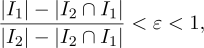
Choose 𝜀 ∈ ℝ satisfying
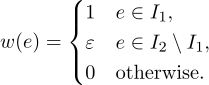
and define w : E → ℝ by
The greedy algorithm selects all of I1 first and, by assumption, cannot add any element of
I2∖ I1, so w(SG) = |I1|. Extending I2 to a maximal independent set I2′ gives
contradicting optimality. Hence the exchange axiom holds and (E,ℐ) is a matroid. □
6 Representable and Graphic Matroids
Definition 6.1.A matroid M = (E,ℐ) is representable over a field 𝔽 if there exists a matrix
A over 𝔽 with columns indexed by E such that S ⊆ E is independent in M if and only if the
corresponding columns of A are linearly independent.
Definition 6.2.Let G = (V,E) be a graph. The graphic matroid of G is the matroid whose
independent sets are the acyclic subsets of E.
Theorem 6.3.Every graphic matroid is representable over ℝ.
Proof.Let V = {v1,…,vn}. Orient each edge of G arbitrarily, and construct A ∈ ℝV ×E by setting,
for each edge e = (u,v) directed from u to v, the column ce to have +1 in row u, −1 in row v, and
0 elsewhere.
We claim that a set of edges is linearly independent if and only if it is acyclic. If e1,…,ek form
a cycle, orienting it cyclically yields ce1 + + cek = 0, so the columns are dependent. Conversely,
if the edge set contains no cycle then each component is a tree; repeatedly removing a leaf shows
inductively that all columns are linearly independent. □
Definition 6.4.A matroid is regular if it is representable over every field.
Remark 6.5.The proof above works over any field (replace −1 by the additive inverse of 1), so
every graphic matroid is regular.
Example 6.6 (Uniform Matroids).The uniform matroid Uk,nis representable over sufficiently
large fields. For instance, U2,4is represented over ℝ by
since every pair of columns is linearly independent. More generally, over an infinite field, choose
n distinct points on the moment curve (1,t,t2,…,tk−1); any k corresponding columns are linearly
independent.
Example 6.7.Uniform matroids need not be regular. U2,4would require four nonzero vectors in
𝔽22such that every pair is linearly independent, but 𝔽22contains only three nonzero vectors: (1,0),
(0,1), (1,1). Hence U2,4is not representable over 𝔽2.
7 Restriction and Union of Matroids
7.1 Restriction
Let M = (E,ℐ) be a matroid and A ⊆ E. The restriction of M to A is
Theorem 7.1.M|A is a matroid on ground set A.
Proof.Non-emptiness: ∅∈ℐ and ∅⊆ A, so ∅∈ℐ|A. Hereditary property: If I ∈ℐ|A and J ⊆ I,
then J ∈ℐ and J ⊆ A, so J ∈ℐ|A. Exchange property: Let I,J ∈ℐ|A with |I| < |J|. Since ℐ is a
matroid, there exists e ∈ J ∖ I with I ∪{e}∈ℐ. As I,J ⊆ A we have e ∈ A, so I ∪{e}∈ℐ|A. □
7.2 Union
Let M1 = (E,ℐ1) and M2 = (E,ℐ2) be matroids on the same ground set E, and define
Theorem 7.2 (Edmonds’ Matroid Union Theorem).(E,ℐ) is a matroid. More generally, the
union of finitely many matroids on E is a matroid.
Remark 7.3.The set-theoretic union ℐ1∪ℐ2 of two independence families is not necessarily a
matroid; the correct construction is the family of unions of independent sets as defined above.
Example 7.4 (Partition Matroid).Let E = E1⊔E2⊔⊔Ekand fix integers 0 ≤ ri≤|Ei|. Call
I ⊆ E independent if |I ∩ Ei|≤ rifor all i. The resulting matroid is called a partition matroid.
For example, let E = {a,b,c,d,e,f}, E1 = {a,b}, E2 = {c,d,e,f}, r1 = 1, r2 = 2. Then
{a,c,d} is independent, while {a,b,c} is not.
A partition matroid arises by taking the uniform matroid Uri,Efor each block, restricting it to
Ei, and forming the union of these restricted matroids — so it is indeed a matroid by the preceding
results.
[6]F. Ardila, Lecture 4 – Matroids:
Greedy Algorithm [video lecture]. San Francisco State University / Universidad de Los Andes,
2007. https://www.youtube.com/watch?v=H4DoReLpGQk.


















 +
+